

Technological advances and the rapid proliferation of digital tools mean that technology proficiency is no longer optional. The ability to use these tools now underlies many everyday activities, from accessing health information and services to maintaining social connections and participating in community life. Developing and maintaining technology proficiency can be a challenge for some older adults, which can limit their ability to fully engage in these activities. When proficiency is low, it can meaningfully constrain participation in behaviors that support health, independence, social connectivity, and community engagement. Understanding technology proficiency has therefore become a critical goal, and that goal depends on having strong, well-developed measures.
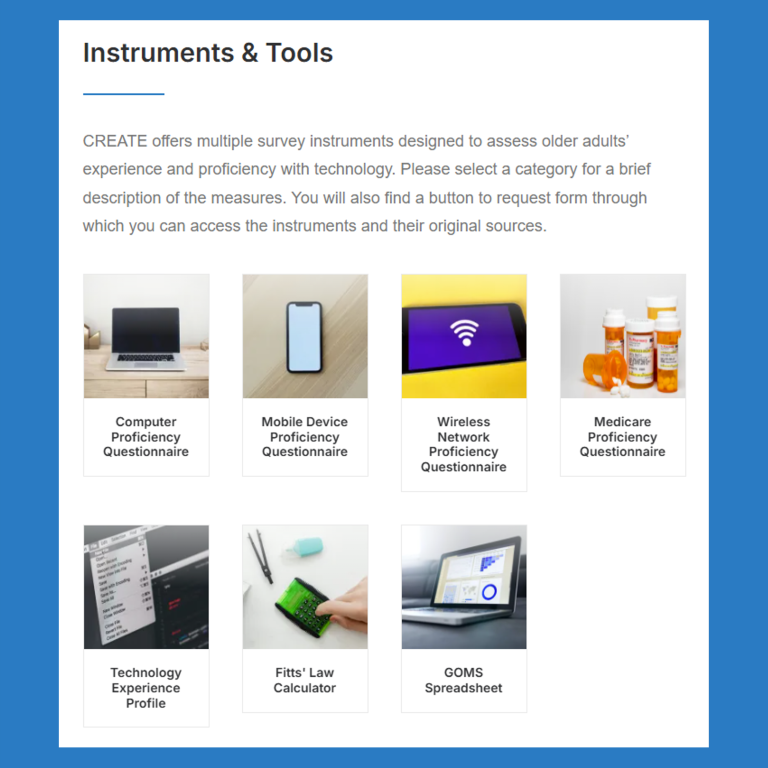
One of the most important recent steps our team has taken toward this goal has been helping to translate key CREATE technology proficiency measures into multiple languages, including the Computer Proficiency Questionnaire (CPQ), Mobile Device Proficiency Questionnaire (MDPQ), and Wireless Networking Proficiency Questionnaire (WNPQ). These tools were originally developed to assess how capable individuals are when using everyday technologies, from email and internet browsing to mobile apps and wireless networks. They have become foundational tools for understanding the digital divide, but until recently, their reach was largely limited to English-speaking populations.
Expanding these measures beyond a single language opens the door to understanding how technology proficiency varies across cultures, infrastructures, and lived experiences. To do this well, translation must go beyond word-for-word substitution. Each item must be carefully adapted so that it captures the same underlying capability in a different cultural and technological context. Our approach relies on rigorous methods, including forward and backward translation, expert review, and pilot testing with target populations, to ensure that each version is both accurate and meaningful.
This work has come to life through a growing network of international collaborations. In Spain, colleagues at the Universidad Católica de Valencia San Vicente Mártir partnered with our team to develop Spanish adaptations of the CPQ and MDPQ for older adults. These versions demonstrated strong reliability and validity, consistent with the original measures. At the same time, the work revealed an important insight: the factor structure of both questionnaires simplified into two broader dimensions. This finding suggests that although the core concept of technology capability is shared, how it is organized and expressed can differ across cultural contexts.
In Japan, collaborators across institutions including Nagasaki University, Osaka Metropolitan University, and Kagoshima University approached adaptation from another angle. Using item response theory, they developed shortened versions of the MDPQ that reduce respondent burden while maintaining strong psychometric performance. This process involved removing or modifying items that were less relevant in the Japanese context. The result is a set of tools that are not only valid, but also efficient and better aligned with how technology is used in everyday life.
Similar momentum is building across Europe and South America. Researchers at Heidelberg University developed and validated a German adaptation of the MDPQ, demonstrating excellent reliability, long-term stability, and expected relationships with age, education, and technology use. At the University of Ljubljana, work has examined how well the structure of the MDPQ aligns with observed smartphone skills, offering important validation against real-world behavior. In Brazil, teams at the Universidade Federal do Paraná conducted a full cross-cultural adaptation of the MDPQ, combining expert review with direct input from older adults to ensure that the measure reflects both language and lived experience.
Taken together, these efforts highlight something fundamental. Technology capability is not simply an individual trait. It is shaped by access, infrastructure, cultural expectations, and patterns of use. Tasks that are central in one context, such as managing files or configuring device settings, may be less relevant in another. Without careful adaptation, measures risk capturing differences in context rather than true differences in capability. The implications of this work are far-reaching. With reliable, culturally grounded measures, researchers can more precisely identify barriers to technology use and design interventions that are responsive to the needs of specific populations. Designers can build tools that reflect how people actually use technology, rather than how we assume they use it. Policymakers can better understand where gaps exist and how to address them. In our own work, this aligns directly with a broader goal of reducing the age-related digital divide and ensuring that emerging technologies are accessible to older adults worldwide.
As technologies evolve and new forms of digital interaction emerge, our measures must evolve as well. Each new translation, validation study, and collaboration strengthens our ability to understand technology capability on a global scale. At its core, this work is about more than measurement. It is about building the foundation for a future in which technology supports health, independence, and connection for everyone, regardless of where they live or the language they speak.
Please refer to our website’s Measure section to learn more about these measures.